
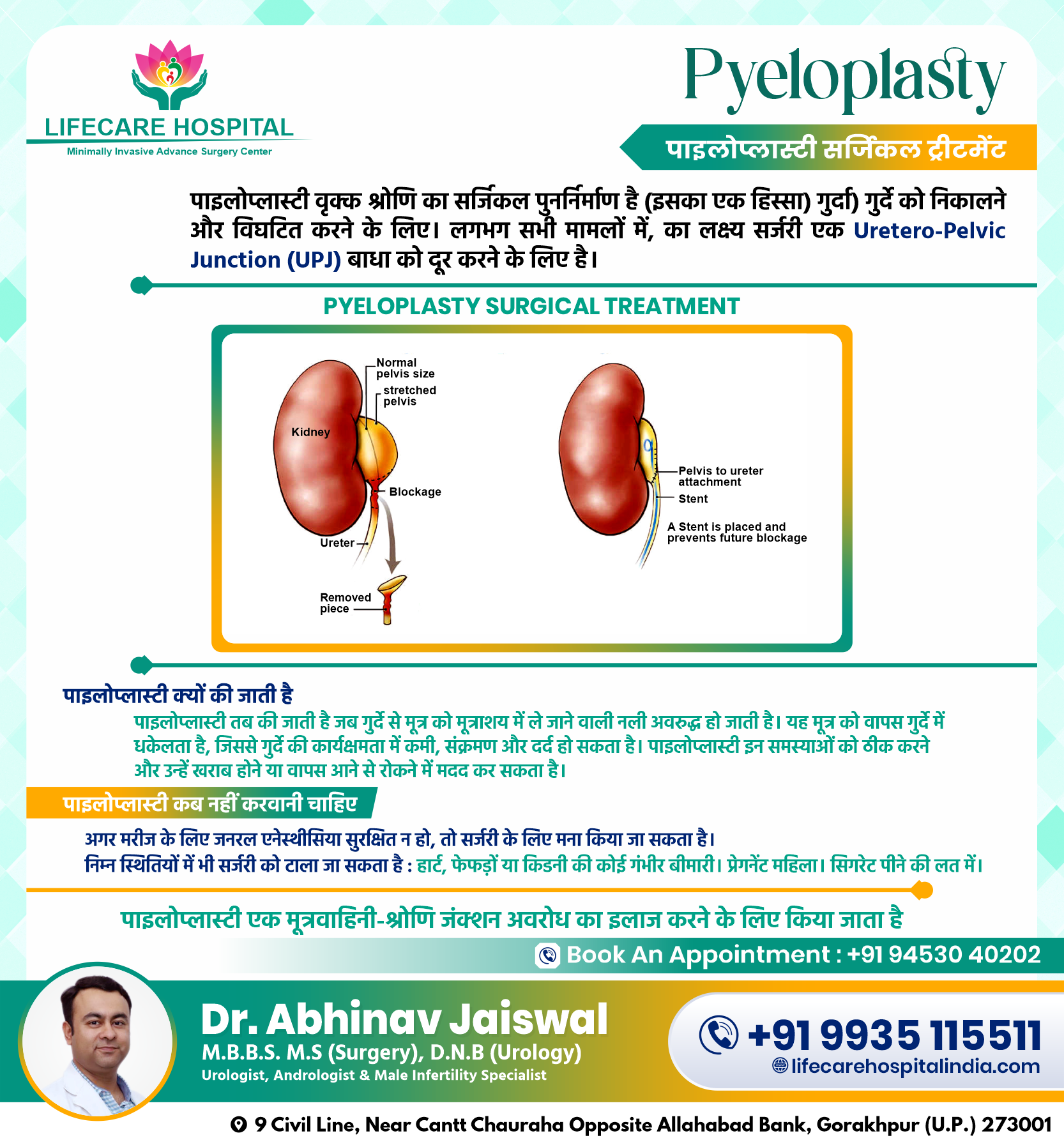
पाइलोप्लास्टी सर्जिकल ट्रीटमेंट
पाइलोप्लास्टी वृक्क श्रोणि का सर्जिकल पुनर्निर्माण है (इसका एक हिस्सा) गुर्दा) गुर्दे को निकालने और विघटित करने के लिए। लगभग सभी मामलों में, का लक्ष्य सर्जरी एक Uretero-Pelvic Junction (UPJ) बाधा को दूर करने के लिए है।
पाइलोप्लास्टी क्यों की जाती है
पाइलोप्लास्टी तब की जाती है जब गुर्दे से मूत्र को मूत्राशय में ले जाने वाली नली अवरुद्ध हो जाती है। यह मूत्र को वापस गुर्दे में धकेलता है, जिससे गुर्दे की कार्यक्षमता में कमी, संक्रमण और दर्द हो सकता है। पाइलोप्लास्टी इन समस्याओं को ठीक करने और उन्हें खराब होने या वापस आने से रोकने में मदद कर सकता है।
पाइलोप्लास्टी कब नहीं करवानी चाहिए ?
अगर मरीज के लिए जनरल एनेस्थीसिया सुरक्षित न हो, तो सर्जरी के लिए मना किया जा सकता है।
निम्न स्थितियों में भी सर्जरी को टाला जा सकता है :
हार्ट, फेफड़ों या किडनी की कोई गंभीर बीमारी।
प्रेगनेंट महिला।
सिगरेट पीने की लत में।
पाइलोप्लास्टी एक मूत्रवाहिनी-श्रोणि जंक्शन अवरोध का इलाज करने के लिए किया जाता है

Pyeloplasty is usually a minimally invasive procedure with just a week or two of recovery time. It can help your kidney function properly and relieve symptoms. As with any surgery, ask your provider about the risks and benefits in your (or your child’s) specific case before having a pyeloplasty.
Recovery. Time to complete recovery is typically 3-4 weeks compared with 8 weeks for open pyeloplasty.
the risks of a pyeloplasty include those of any surgery, such as infection, redness, swelling, bleeding, or failure of the operation to fix the problem. During surgery on the kidney, however, urine can leak into other areas and cause irritation.
Many studies considered more than a 5% increase of postoperative DRF as improvement in renal function [6, 8, 12‒14]. Mcaleer et al. [4] showed renal function did not improve after pyeloplasty, regardless of the initial level of relative function.

Recent Comments